| The "Penny Post" was first introduced in Britain
in 1840 by Rowland Hill. The idea was simple, a penny stamp paid for
the postage of a letter or card to anywhere in Britain. This simple
idea paved the way for the sending of the first Christmas cards. Sir
Henry Cole tested the water in 1843 by printing a thousand cards for
sale in his art shop in London at one shilling each. It was designed as
a way to offer seasonal greetings without having to write out hundreds
of personal messages.
During the early part of the nineteenth century, 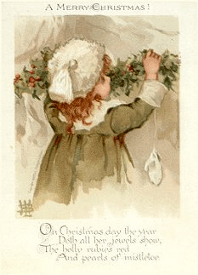 Americans
people didn't send cards, first because there were none, and second,
any mail sent required the receiver to pay the postage. People didn't
want to burden the card receiver with postage due. When postal
regulations changed and the card recipient no longer had to pay the
postage, American Victorians embraced the custom of sending
commercially printed Christmas cards. Americans
people didn't send cards, first because there were none, and second,
any mail sent required the receiver to pay the postage. People didn't
want to burden the card receiver with postage due. When postal
regulations changed and the card recipient no longer had to pay the
postage, American Victorians embraced the custom of sending
commercially printed Christmas cards.
Cards were varied in size, shape and materials.
Designs ranged from charming little vignettes by artists such as Kate
Greenaway to the lithographs of the Arts and Crafts movement. Many
cards were extremely elaborate with gilded, embossed, shaped, pop-up
and pierced forms. Victorian cards sported fancy silk fringe, lace,
satin, sachets, tinsel, feathers, fold-outs, pop-outs, and pull tabs
for animation.
In 1875 that Boston lithographer Louis Prang, who
came to the United States from Germany in 1850, began publishing cards,
earning the title "father of the American Christmas card". The early
cards from L. Prang & Co. were small, usually measuring two and
half by four inches, and they were printed on one side only. Prang's
cards were costly (up to a dollar each) and initially featured not
images of the Madonna and Child, a decorated tree, or even Santa Claus,
but colored floral arrangements of roses, daisies, gardenias,
geraniums, and apple blossoms, or pictures of children, birds and
angels. However the cost and design of Prang's cards caused them to
fall from grace and he was forced out of business in 1890. It was the
cheap penny Christmas postcards imported from Germany that remained the
vogue until World War I.
In the tradition of the season, the Hackettstown
Historical Society is decorated for the holidays, including a display
of antique Christmas cards. "Our new displays and decorations include
antique ornaments and toys, and vintage clothing, giving museum
visitors a glimpse into the holiday traditions of old,"says Judy Truex,
HHS Secretary.
The Hackettstown Historical Society Museum is
located at 106 Church Street, Hackettstown. It is open on Wednesdays,
Fridays and Sundays from 2-4 pm. Visitors and volunteers are always
welcome.
|